A contractor emails the same material list to you and two other supply houses. Whoever sends a priced quote back first usually has the best shot at the job. Meanwhile your inside sales rep is working down the list line by line: figuring out what “3/4 EMT conn, the steel ones” means, looking up a competitor part number, checking the customer’s price, and keying it all into the ERP. That first pass is exactly the work AI quoting software is built to take off their desk.
AI quoting software reads the request, matches each line to an item in your catalogue, prices it and hands your rep a draft quote to check. Several vendors now sell it to distributors, and a few distributors are having their own built.
This guide is written for owners, GMs and inside sales managers at electrical, plumbing and HVAC, industrial/MRO and fastener distributors. It covers what AI quoting software actually does, what it costs, where it still breaks, and how to test it on your own quote requests before you sign anything.
What AI Quoting Software Does
Strip away the marketing and almost every tool in this category does the same five steps. The difference between them is how well they handle each step on your requests.
- Reads the request. Emails, PDFs, spreadsheets, scanned material lists and, in the better tools, photos of handwritten lists. It pulls out each line: description, quantity, unit and any part numbers.
- Matches each line to your item. A vague description, a manufacturer part number, a competitor’s part number or the customer’s own number gets matched to an item in your ERP. This is the hard part and where most of the value is.
- Prices it. It applies the customer’s price level, contract or matrix pricing from your ERP, not list price.
- Flags what it isn’t sure about. A good tool gives each line a confidence level and marks the ones a rep needs to look at, instead of guessing silently.
- Creates a draft quote. Ideally as a quote in your ERP (Prophet 21, Eclipse, SX.e, NetSuite, Acumatica, Business Central, Sage), not a PDF your rep has to retype. The rep reviews it, fixes the flagged lines and sends it.
In fact, that last point matters more than it sounds. A tool that produces a nice-looking PDF but leaves your rep to key the quote into the ERP has only saved half the work.
A Real-World Example: One Messy Quote Request
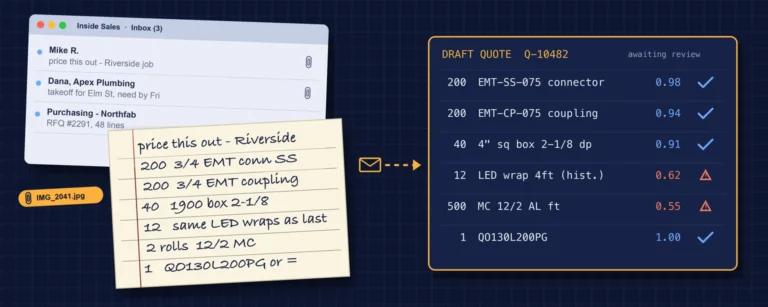
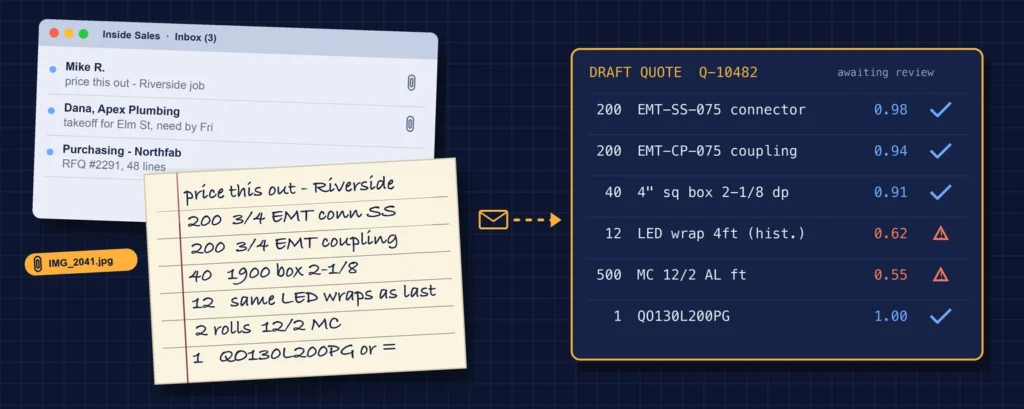
Here is the kind of request that lands in an electrical distributor’s inbox every day. (Made up, but typical.)
Hey, can you price this out for the Riverside job, need by Thursday
A typical contractor quote request
200 – 3/4 EMT conn set screw steel
200 – 3/4 EMT coupling
40 – 1900 box 2-1/8 deep
12 – same LED wrap fixtures as last time
2 rolls 12/2 MC
1 – Square D QO130L200PG or equal
Thx, Mike
A rep who knows this customer handles it in their head. Software, on the other hand, has to work out each line:
| Request line | What the software has to do | Typical outcome |
|---|---|---|
| 200 – 3/4 EMT conn set screw steel | Match a description to one item; pick steel over die-cast | Matched, high confidence |
| 200 – 3/4 EMT coupling | Same, but the customer didn’t say set screw or compression | Matched to their usual item, or flagged |
| 40 – 1900 box 2-1/8 deep | Trade shorthand for a 4″ square box | Matched if your catalogue data is decent |
| 12 – same LED wrap fixtures as last time | Look up this customer’s order history | Flagged unless the tool reads past orders |
| 2 rolls 12/2 MC | Convert rolls to feet; 250 ft or 1,000 ft? | Flagged: unit of measure |
| 1 – QO130L200PG or equal | Exact part number; check stock and lead time | Matched |
In other words, the goal isn’t a tool that gets all six lines right on its own. It’s a tool that gets four right, clearly flags the other two, and lets your rep finish the quote in two minutes instead of twenty.
Why Quote Speed Matters for Distributors
Contractors and plant buyers send the same list to several suppliers. Price matters, but so does speed: the supplier who replies first often sets the price everyone else is compared to, and sometimes gets the order before the others reply at all.
Vendors in this space report that a manual quote takes a rep 15 to 45 minutes by hand. Those are vendor figures, but they match what inside sales managers tell us. Here is some rough math, and it is only a guess:
40 quote requests a day at 20 minutes each is a little over 13 hours of rep time, close to two full-time people doing nothing but building quotes.
Of course, your numbers will be different. The point is that quoting is one of the few places where a distributor can win more business and free up hours at the same time.
Where AI Quoting Still Breaks
Every vendor demo uses a clean PDF. But your inbox doesn’t look like that. These are the cases to test before you buy:
- Photos of handwritten lists. Plumbing and HVAC counters see these daily. Some tools read them well, some don’t accept images at all.
- Vague descriptions. “The good ones”, “same as last time”, “or equal”. These need the customer’s order history, not just your catalogue.
- Competitor cross-references. Industrial, MRO and fastener RFQs are full of other distributors’ and manufacturers’ part numbers. Matching depends on cross-reference data you may or may not have in your ERP.
- Units of measure. Box vs each, rolls vs feet, reels and cut lengths for wire and cable. A wrong unit is the fastest way to send a quote that’s off by a factor of 100.
- Customer-specific pricing. Contract prices, job pricing and special pricing agreements from manufacturers. If the tool can’t read them from your ERP, your rep is repricing every line.
- Superseded and discontinued items. The customer asks for a part that’s been replaced. The tool should suggest the replacement, not report “no match”.
- Messy catalogue data. If your own item descriptions are inconsistent, matching suffers. Some cleanup is often part of the project.
- Writing back to the ERP. On-premises ERPs like older Prophet 21 or Eclipse installs may need a VPN or middleware, and sign-off from your ERP partner.
Even so, none of these are reasons not to automate quoting. They are reasons to test any tool on your own requests, including the ugly ones, before you commit.
Your Options: Three Kinds of AI Quoting Software
1. Self-serve quoting tools
Low monthly price, sign up and start uploading documents. They work well for simple PDFs and clean part numbers, and are a reasonable way to see what AI extraction can do. However, they tend to struggle with cross-references, customer pricing and writing quotes back into your ERP.
2. Distribution AI platforms
Vendors such as Proton.ai, Canals, Distro, Morsa, Conexiom and Turian sell quote and order automation built for distributors, with integrations for the main distribution ERPs. Proton.ai, for example, launched its order and quote entry product in July 2026. These are serious products and a good fit for larger distributors who want one platform and have the team to roll it out. Expect a sales process, onboarding and an annual subscription.
3. A custom build you own
A developer builds quote drafting around your ERP, your catalogue and your customers’ formats, and you own the result. On the other hand, it costs more up front than a subscription and needs a partner you trust to support it. It suits distributors whose requests are unusual (fixture schedules, cut lengths, heavy cross-referencing), who want quotes and emailed orders handled in one system, or who want to start small with their busiest customers and grow from there.
This is what we do at CodeClever, as part of our AI and automation services. We’ve built workflow automation with tools like n8n and Retool for other industries. We’re early with distributors, which is why we start every conversation with a free test on your own quote requests rather than a sales deck.
What AI Quoting Software Costs
Prices change quickly in this category, so treat these as a starting point and check current pricing with each vendor.
| Type | Typical price | What to watch |
|---|---|---|
| Self-serve tools | From about $50 to $1,500 a month on published plans (for example Quotable and HyperQuote, per Morsa’s 2026 guide) | Page or document limits; ERP write-back is often missing |
| Distribution AI platforms | Mostly not published; quoted after a demo, often usage-based or annual | Onboarding time, minimum contract, per-document fees as volume grows |
| Custom build (our pricing) | From $6,000 for a focused quoting build, up to about $20,000 for a full order and quote desk, plus support from $500 a month | Scope: which customers and formats are covered first |
What a custom build includes at each level
- Focused quoting build, from $6,000 (2 to 3 weeks). Quote requests only. When a customer emails a material list or RFQ, it’s read and matched for your busiest customers’ formats, priced with their pricing, and created as a draft quote in your ERP for a rep to approve. A good fit if you want to prove the value before committing more.
- Full order and quote desk, $12,000 to $20,000 (4 to 6 weeks). Everything in the focused build, plus purchase orders. When a customer emails a PO or reorder spreadsheet, it’s entered in your ERP as a held sales order for a rep to approve, so quotes and orders both stop being retyped. It covers your top 30 or so customer formats and learns each customer’s own part numbers. Flagged lines from quotes and orders go to one review screen, and a weekly report shows how accurate the system is. A good fit if your desk spends as much time entering orders as building quotes.
- Support from $500 a month. New customer formats as they come in, monitoring, accuracy tuning and AI usage costs.
The exact price depends on your ERP, how many customer formats you want covered at the start and how messy your requests are. As a result, we give a fixed price only after the free test, once we’ve seen your actual requests.
AI Quoting vs Hiring Another Inside Sales Rep
For most distributors the real comparison isn’t one software tool against another. It’s software against the next hire. When quote requests pile up, the usual answer is to add another inside sales rep. Here is a rough comparison. These are our estimates, so check them against your own payroll:
| Another inside sales rep | Focused AI quoting build | |
|---|---|---|
| First-year cost | About $55,000 to $75,000 with salary, benefits and payroll taxes (estimate) | From $6,000 build plus support from $500 a month, about $12,000 in year one |
| Time to be useful | Weeks to hire, then months to learn your catalogue, customers and part numbers | 2 to 3 weeks, measured on your past requests before it goes live |
| Capacity | One person’s day; quotes wait when they’re out or busy | Drafts quotes as requests arrive, including after hours |
| When they leave | Their product knowledge leaves with them | Matching rules and customer history stay in the system |
However, this doesn’t replace your reps. Customers still want a person who knows the product and can pick up the phone. What it can do is let the team you already have handle more quotes, faster, so the next hire can be someone who sells rather than someone who types.
How to Evaluate AI Quoting Software
For this reason, ask every vendor, including us, to prove it on your requests. A good evaluation looks like this:
- Pick 10 recent quote requests. Include the messy ones: a photo, a long RFQ with cross-references, a “same as last time”.
- Measure line by line. What percentage of lines were matched correctly with no rep changes? How many were flagged, and how many were wrong but not flagged? That last number matters most.
- Check the pricing. Did it use each customer’s real price, or list price?
- See where the quote ends up. A draft quote in your ERP, or a file your rep retypes?
- Ask who approves. Nothing should reach a customer without a rep’s click.
- Ask about your data. Where documents are stored, whether they are used to train models, and what access the tool needs to your email.
Common Concerns About AI Quoting
“It will quote the wrong part.”
Sometimes it will, which is why quotes should always land as drafts for a rep to approve, with low-confidence lines highlighted. Accuracy should be measured on your past requests before you switch it on, not taken from a vendor’s slide.
“Our customers’ data has to stay private.”
A well-built system reads only the quote inbox it is given access to, through scoped Microsoft 365 or Google permissions, uses AI services that don’t keep or train on your data, and keeps a log of every quote it drafts.
“Our IT team has no time.”
For the most part, the work sits with the vendor or developer. Expect a few hours of your ERP administrator’s time to set up access and test, not a months-long IT project.
AI Quoting Software: Frequently Asked Questions
AI quoting software reads quote requests that arrive by email, PDF, spreadsheet or photo, matches each line to an item in your catalogue, applies the customer’s pricing and creates a draft quote for a sales rep to review and send.
CPQ (configure, price, quote) software helps a rep build quotes for configurable products using rules. AI quoting, however, starts from the customer’s own request and turns it into a draft quote. Most distributors quoting from material lists and RFQs need the second.
Many tools do, along with NetSuite, Acumatica, Business Central and Sage. Check that the tool creates the quote inside your ERP rather than just a PDF, and ask how it connects to on-premises installs.
It depends on your requests and catalogue data. Clean part numbers match almost every time, while vague descriptions, handwritten lists and cross-references are harder. So the only reliable number is one measured on your own past quote requests.
Self-serve tools cost roughly $50 to $1,500 a month. Distribution platforms usually quote after a demo. A custom build starts from about $6,000, or about $20,000 for a full order and quote desk, plus support from $500 a month.
Usually, yes. By our rough estimate, a rep costs $55,000 to $75,000 a year with benefits and payroll taxes, while a focused AI quoting build costs about $12,000 in its first year. It doesn’t replace your reps; instead, it lets your current team handle more quotes.
Test AI Quoting on Your Own Quote Requests, Free
The fastest way to find out whether AI quoting works for your business is to try it on your own requests. Send us 10 recent quote requests (or 20 emailed orders), under NDA. Include the messy ones.
Within 48 hours we’ll send back a line-by-line report: what we would have matched and priced correctly, what we’d have flagged for a rep, and an estimate of the hours it would save. Then we walk you through it on a call.
Request your free quote test or email hello@codeclever.tech.